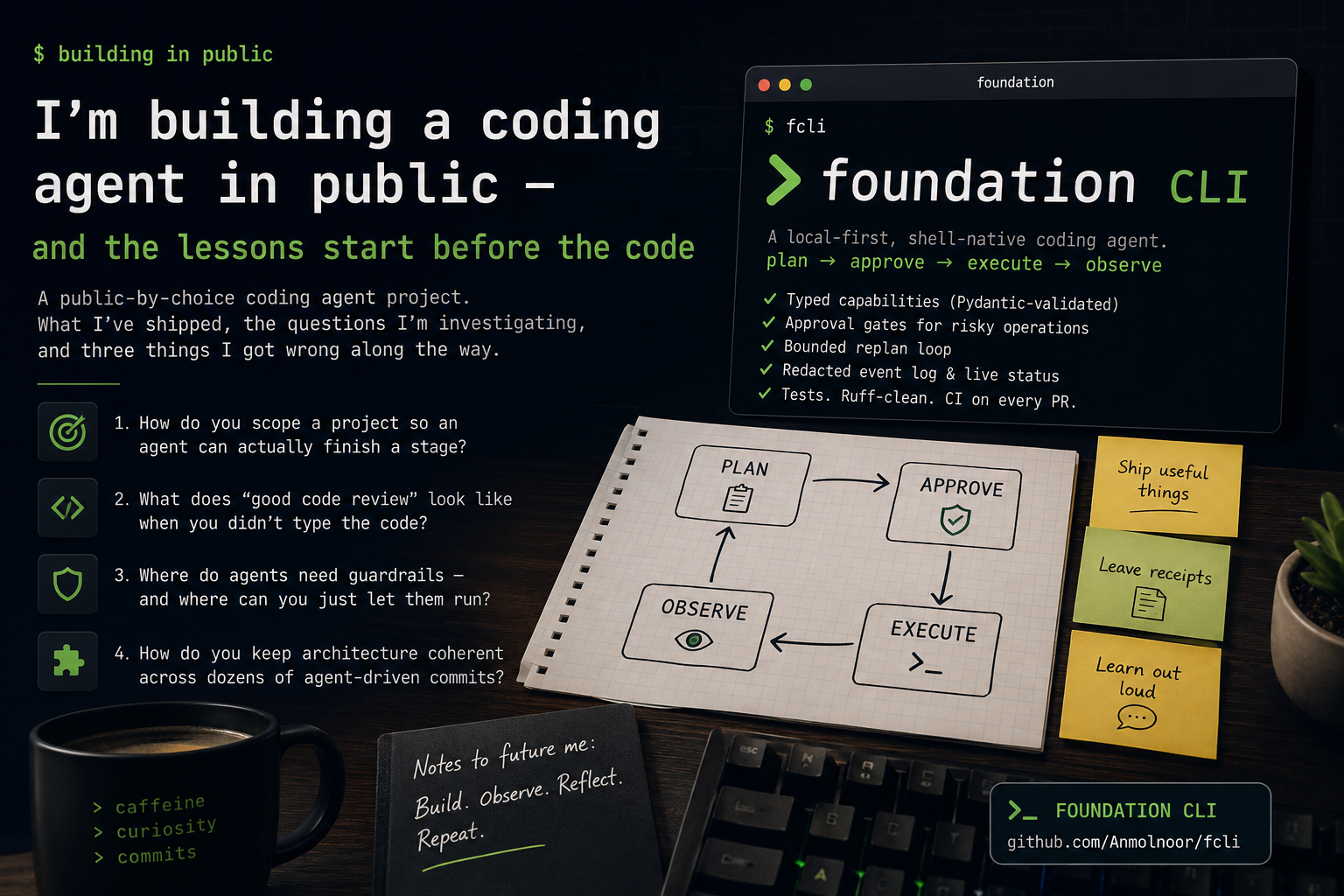
I'm building a coding agent in public — and the lessons start before the code
1. The setup
Sometime in the last few months, “AI coding agent” stopped feeling like a demo and started feeling like a colleague — one with weird failure modes, occasional brilliance, and a strong opinion about TODO comments. I wanted to learn how to work with one seriously.
Not “ask ChatGPT to write a regex” seriously. Not “let Cursor autocomplete a function” seriously. Actually-shipped-software, multiple-commits-a-day, somebody-else-can-clone-this seriously.
So I started a project I’d run entirely in the open: Foundation CLI. The plan was simple — pick something I’d want to use, build it side-by-side with an agent, leave the receipts public, and write down what I learned.
This post is one of those receipts.
2. What got built (so far)
Foundation CLI is a local-first, shell-native coding agent. Specifically:
- An explicit plan → approve → execute → observe loop. Nothing happens until I see the plan and either type
[approve]or[deny]. - Typed capabilities for files and git. The agent can read, write, edit, apply diffs, run git commands — but each one is a Pydantic-validated request with a known set of error codes, not a freeform shell call.
- A bounded replan loop (hard caps of 32 iterations × 40 actions per iteration × 200 total per turn) so the agent can’t spin forever on a stuck plan.
- A redacted event log that streams every plan, action, observation, and verification outcome into a SQLite history database, plus an opt-in NDJSON / Unix-socket / HTTP-SSE feed you can pipe into your own monitor.
- A live status line during a turn — one updating row by default, press
?for an expandable view of completed steps and the in-flight one. - 380 tests. Ruff-clean. CI on every PR. A
doctorsubcommand that prints risk class, trust tier, and declared side effects per capability.
You can read the full README in the repo. The shape of the system is genuinely useful — I use it daily — but it’s also missing the things you’d need from a product (model breadth, plugin system, polished UX, a roadmap, an actual user base). And that’s fine, because:
3. The four questions I’m actually investigating
The README puts these up front, and they’re the thing I’d want a future version of myself to remember.
3.1 How do you scope a project so an agent can actually finish a stage?
This one I’m getting opinionated about. Vague prompts (“add tests for the file service”) produce slop. Sharp specs with a definition-of-done (“add tests covering FileService.read for binary, missing, oversized, and non-utf8 inputs; integrate with the executor dispatch test in tests/test_executor.py; one fixture per case; run pytest until green”) produce clean commits.
The whole plans/v3/ directory in the repo is me iterating on this question. Each stage is a single Markdown file. Each stage maps roughly 1:1 to a commit. That correspondence is the thing — when you see it work, you stop wanting to “just chat with the agent.”
3.2 What does “good code review” look like when you didn’t type the code?
Honest answer: I don’t have this fully figured out. But the heuristics I’m using:
- Read every diff. Not skim — read. If I can’t explain a hunk in 30 seconds, it doesn’t ship.
- Tests are not optional. If the change is interesting, it has a test. If the test is just exercising the happy path, it’s not a test, it’s a fixture.
- Architecture coherence > local correctness. A change that works in isolation but introduces a fifth way to do the same thing is worse than a slightly less elegant change that uses the existing pattern.
- The agent’s confidence ≠ my confidence. “I added comprehensive error handling” usually means “I added six try/except blocks that swallow real bugs.”
This stuff is muscle memory more than a checklist. The only way I’ve found to build it is to actually do it, daily, in a codebase that matters.
3.3 Where do agents need guardrails — and where can you just let them run?
Strong opinions, weakly held:
- Guardrails: type-validated request/response models for anything with side effects. Approval gates on risky ops (commits, writes outside the workspace, anything that touches git history). A bounded loop so a stuck planner can’t burn a million tokens. A redacted log so you can audit what happened after the fact.
- No guardrails needed: read-only operations. Planning. Refactors that the test suite will catch. Reformatting. Anything where the cost of a wrong action is “I revert one commit.”
The line is whether a mistake is recoverable. Recoverable → let it run. Not recoverable → make the agent ask. Read-only and git stage are auto-allowed; git commit requires approval, because once history moves, “undo” is no longer cheap.
3.4 How do you keep architecture coherent across dozens of agent-driven commits?
This is the hardest one. Agents are local thinkers — they’ll do the right thing in the file in front of them and quietly grow a fourth implementation of the same idea two directories over.
What I’m trying:
- A
plans/directory that’s not just a TODO list but an architectural narrative. New stages reference earlier stages. - A
CHANGELOG.mdwritten by hand, because making the agent summarize its own work eats the lessons. - Periodic “say the system back to me” prompts where I make the agent describe how a subsystem works and then I fact-check it against the code.
- And — boring but powerful — being willing to delete things. If the agent introduced an abstraction that hasn’t earned its keep after a week, it goes.
4. One concrete lesson: stages > tasks
The single most useful framing change I’ve made: stop thinking in tasks, start thinking in stages.
A task is “add validation to the input parser.” That’s an instruction. It has no definition-of-done, no scope boundary, no test plan, and a thousand possible interpretations.
A stage is a Markdown file like plans/v3/03-native-git-capabilities-and-approval-boundaries.md. It has:
- A context paragraph (why this exists).
- Concrete file paths to touch and the order to touch them in.
- A verification section (what “done” looks like, end-to-end).
- An explicit out-of-scope list.
Hand the agent a stage and it produces a commit you can git diff once and merge. Hand it a task and you’ll review three rewrites of the same logic, two of them with new abstractions you didn’t ask for.
The trick isn’t writing better prompts. It’s writing better specs. Stages are specs.
5. Three things I got wrong (and what they taught me)
The post would be dishonest if I only described what worked. The corrections are where most of the real learning sits.
5.1 A boolean wasn’t enough for “did the tests pass?”
Early v3 had a single verified: bool flag per turn. The orchestrator ran the verification command, looked at the exit code, and stamped True or False. Clean and broken.
The bug surfaced on a checkout where pytest wasn’t installed: the missing-binary error was caught upstream, verified defaulted to True, and the agent reported a successful turn against a workspace that had never run a test.
The fix wasn’t “be more careful with exit codes.” It was admitting the boolean was the wrong shape. v3’s hardening stage replaced it with a four-state enum — PASSED, FAILED, UNAVAILABLE, NOT_ATTEMPTED — defined in src/foundation/models/orchestration.py. UNAVAILABLE distinguishes “we tried to run the check but the binary wasn’t there” from FAILED (“we ran the check and the assertions broke”), and the presenter renders distinct notices for each.
The lesson: a binary verdict couldn’t represent “we couldn’t even run the check.” The moment I tried to write the right warning text, the underlying field clearly couldn’t carry the information. Names matter; shapes matter more.
5.2 You can’t spec loop budgets from theory. You have to watch the agent work.
The original v3 spec set the bounded replan loop to max 4 iterations × 5 actions per iteration × 20 total. Those numbers came from the napkin: an agent shouldn’t need more than four planning rounds to converge, five actions per round felt generous, and capping the total at 20 prevented runaway turns.
It was wrong by almost an order of magnitude. The first real coding turn — a multi-file refactor with verification — hit the iteration cap, looked done because the loop terminated cleanly, and left half the work undone. I thought my code was buggy. The cap was.
The fix was to instrument what real turns actually consumed and raise the limits where they wanted to sit: 32 × 40 × 200. The median turn doesn’t come close; the high cap is for the long tail.
The lesson: numbers in a spec are theory; numbers in a running loop are evidence. I’d written the original limits without watching the orchestrator under load, and the first hour of usage rendered three quarters of my a-priori reasoning irrelevant. You can’t replace running the system with thinking about it.
5.3 The agent will quietly leave you with a dirty index
This is the one I felt most embarrassed by, because the failure is obvious in hindsight.
The user types something like “fix the failing test and commit”. The agent edits the file, runs the test (it passes), stages the change, and finishes the turn — zero further actions. The orchestrator sees a clean exit. Half an hour later the user tries to push and finds a workspace with staged changes and no commit.
From the agent’s perspective, every action it planned succeeded. From the user’s, the work isn’t done. They said “commit.” The commit never happened.
The fix is a small invariant in the orchestrator: if the user’s stated intent contained “commit” and the final iteration ends with staged files but no git.commit action planned, raise a GovernanceNotice and flip session status to PENDING_APPROVAL instead of COMPLETED. The agent can’t silently leave a dirty index without flagging it.
The lesson: agents reason locally; they can’t see “this looks finished but actually isn’t.” The fix is almost always to make the implicit explicit — turn an unspoken assumption into a structured signal the system can check on.
6. Why I’m gating contributions
The repo is public and I want real contributors. But late 2026 is also when GitHub trackers are getting buried in AI-generated PRs and issues that nobody actually thought about — opened by agents, never read by their submitter, often slightly wrong in ways that cost more time to triage than to fix.
So I’m borrowing the contribution gate that Mario Zechner built for pi-mono:
- New issues and PRs from new contributors are auto-closed by a GitHub Action with a friendly explanation.
- A maintainer comment of
lgtmion an issue allows that user’s future issues.lgtmallows their future issues and PRs. - The allowlist is just a text file in
.github/, updated automatically by another workflow.
This isn’t gatekeeping for its own sake — it’s a respect signal. If you took the time to read CONTRIBUTING.md, file a sharp issue, and engage in good faith, you’ll get reopened almost immediately. If you didn’t, the auto-close is doing both of us a favor.
The one rule, which I’m also borrowing from pi-mono: you must understand your code. AI-generated code is fine. Submitting AI-generated code you don’t understand is not.
7. What’s next, and how to follow
v4 just shipped, alongside the rest of v0.2.0. The visible piece is a live status line during a turn — one updating row by default, press ? for an expandable view of completed steps and the in-flight one. Underneath that, every session now writes a redacted NDJSON event log to disk by default, and you can opt into a Unix-socket or local HTTP/SSE transport so an external monitor can subscribe to a running fcli in near-real-time. The loop’s no-progress detector got a fix too: idempotent re-plans no longer trip the “stuck” classifier and end clean turns as red failures.
What’s after that is unwritten. The next thing I’m circling is plugin shape — but I haven’t earned an opinion yet. Specs land in plans/ as I write them.
If you’re figuring out the same questions, two things would help:
- Read a stage in
plans/andgit logthe commits that came out of it. That’s the “how was this built” tour. - Tell me what’s working for you. Issues are open, the gate is friendly, and “I disagree with X” is a perfectly good first issue.
Repo: https://github.com/Anmolnoor/fcli
I’ll write more as I learn.